Counting words with dictionaries
The idea behind real spam filters
Introduction to Data Science and Machine Learning · Md Mahbub E Noor · University of Barishal
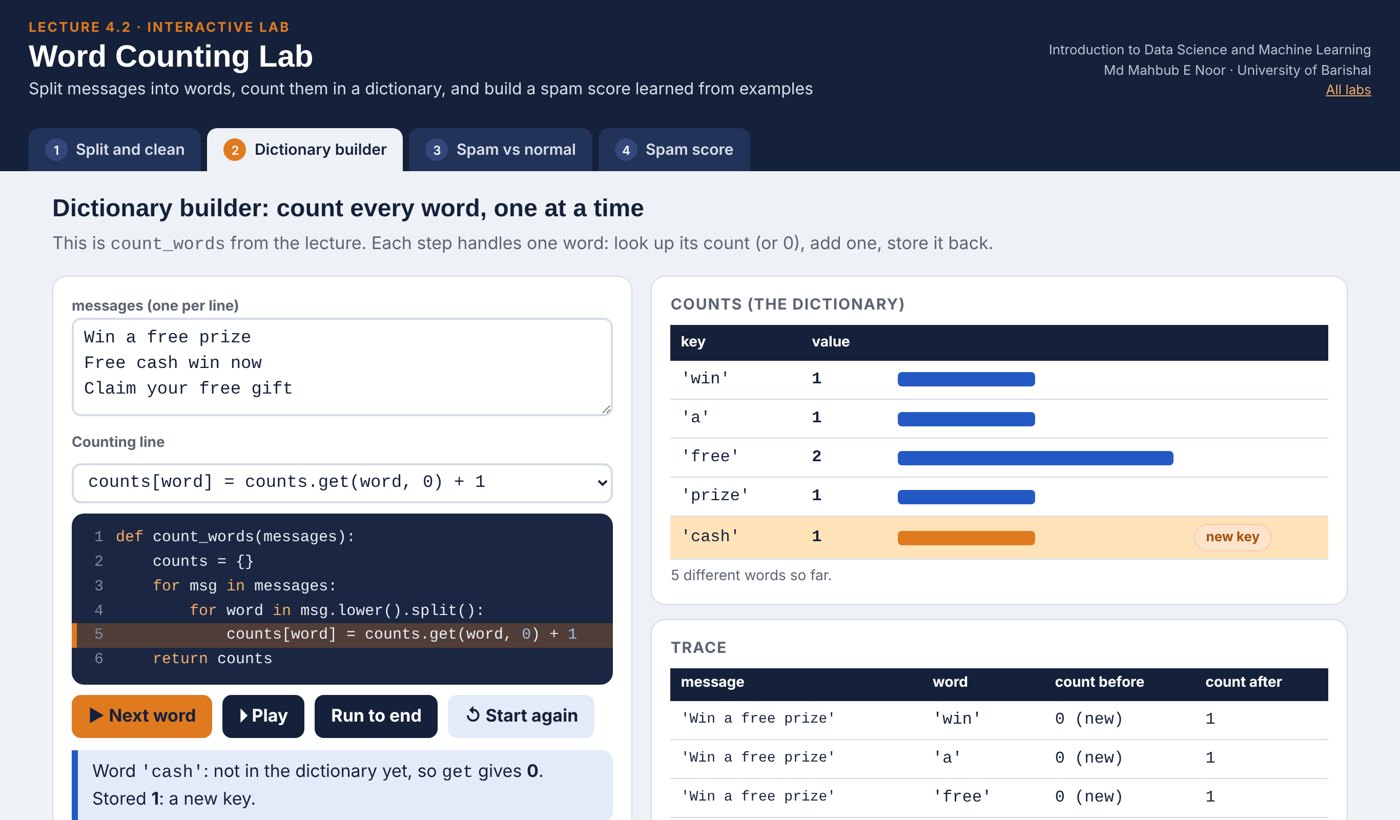
counts[word] = counts.get(word, 0) + 1
Where we are: Lecture 4, part 2
Today you will
- 1Recap: package the spam check as a function
- 2Split a message into words
- 3Store word counts in a dictionary
- 4Count words across many messages
- 5Build a spam score learned from examples, not typed rules
Recap from 4.1: a spam check as a function
defdefines a function: a named, reusable blockmessageis the input (a parameter)returnhands back the answer and stops- Call it by name:
is_spam("...")
def is_spam(message):
    text = message.lower()
    for word in ["free", "win", "prize"]:
        if word in text:
            return True
    return False

print(is_spam("Win a phone today"))
print(is_spam("See you at 5"))True False
Split a message into words
.split()cuts text at spaces into a list- Combine with
.lower()so WIN and win match - Punctuation stays stuck:
prize,is notprize - Cleaning text matters; scikit-learn will help in Lecture 6
message = "Win a FREE prize, win now"
words = message.lower().split()
print(words)
print(len(words))
['win', 'a', 'free', 'prize,', 'win', 'now']
6
Dictionaries: look up a value by name
- Curly braces:
{key: value} - Look up with
counts["win"] - Add or change:
counts["prize"] = 1 - Like a word book: word → how many times we saw it
counts = {"win": 2, "free": 1}
print(counts["win"])
counts["prize"] = 1
counts["win"] = counts["win"] + 1
print(counts)2
{'win': 3, 'free': 1, 'prize': 1}Count every word in many messages
counts.get(word, 0) means: the current count, or 0 if we have never seen this word.
def count_words(messages):
    counts = {}
    for msg in messages:
        for word in msg.lower().split():
            counts[word] = counts.get(word, 0) + 1
    return counts

spam_msgs = ["Win a free prize", "Free cash win now",
             "Claim your free gift"]
spam_counts = count_words(spam_msgs)
print(spam_counts){'win': 2, 'a': 1, 'free': 3, 'prize': 1, 'cash': 1,
'now': 1, 'claim': 1, 'your': 1, 'gift': 1}Tracing count_words, word by word
The first two spam messages. counts.get(word, 0) is the count before this word; the dictionary then stores one more.
counts = {}
for msg in messages:
    for word in msg.lower().split():
counts[word] = counts.get(word, 0) + 1| message | word | count before | count after |
|---|---|---|---|
| 'Win a free prize' | 'win' | 0 | 1 |
| 'Win a free prize' | 'a' | 0 | 1 |
| 'Win a free prize' | 'free' | 0 | 1 |
| 'Win a free prize' | 'prize' | 0 | 1 |
| 'Free cash win now' | 'free' | 1 | 2 |
| 'Free cash win now' | 'cash' | 0 | 1 |
| 'Free cash win now' | 'win' | 1 | 2 |
| 'Free cash win now' | 'now' | 0 | 1 |
Next row: arrow key or the ▶ button. Predict it first!
Watch it run: count_words
WATCH FOR
- messages is a second name for the list spam
- counts grows by one word at a time
- 'cash' appears twice, so its count reaches 2
- return hands the whole dictionary back
Silent video: press play, pause any time.
Now count normal messages too
- Same function, different examples
- Compare: how often is a word in spam vs. normal?
- "free": 3 in spam, 0 in normal
- "now" appears in both, so it is a weaker clue
ham_msgs = ["See you at the library",
            "Is class at 10 now",
            "Can you send the notes"]
ham_counts = count_words(ham_msgs)
for w in ["free", "now", "you"]:
    print(w, spam_counts.get(w, 0),
ham_counts.get(w, 0))free 3 0 now 1 1 you 0 2
A spam score learned from examples
Add a point for each word seen in spam, subtract one for each word seen in normal messages.
def spam_score(message):
    score = 0
    for word in message.lower().split():
        score = score + spam_counts.get(word, 0)
        score = score - ham_counts.get(word, 0)
    return score

for msg in ["Free prize for you", "See you in class",
            "Claim cash now"]:
print(spam_score(msg), msg)2 Free prize for you -4 See you in class 2 Claim cash now
From typed rules to learned counts
Lecture 3: rules we typed
- A person picks the words
- Every new trick needs a new rule
- Yes or no, no sense of strength
- Knows nothing we did not tell it
Lecture 4: counts we learned
- Examples pick the words
- More examples, better counts
- A score: stronger or weaker evidence
- Finds clues we never thought of
Your turn 7 minutes
- 1Write
word_count(message)that returns how many words a message has - 2Test it on two messages
- 3Add 2 spam and 2 normal messages of your own to the lists
- 4Recount, then test
spam_scoreon a new message
def word_count(message):
    ...
    return ...

print(word_count("Win a free prize"))  # expect 4
Starter code: replace the ... with your own code
Common mistakes with functions and dictionaries
Read the last line of an error first. It names the problem.
| What you typed | What Python says | What it means |
|---|---|---|
print(spam_counts["hello"]) | KeyError: 'hello' | The key does not exist. Use spam_counts.get("hello", 0). |
def double(x):
    x * 2
print(double(4)) | None | No error, but None: the function forgot to return. |
print(spam_score()) | TypeError: spam_score() missing 1 required positional argument: 'message' | The function needs an input. Pass a message. |
Interactive lab: Word Counting Lab
In the lab you can
- Split and cleanSee .lower() and .split() turn a message into words.
- Dictionary builderWatch counts.get(word, 0) + 1 fill the dictionary.
- Spam vs normalCompare word counts in spam and normal examples.
- Spam scoreScore new messages, then teach the filter more examples.
Opens in a new tab and works offline. All labs: labs/START_HERE.html
Today's toolkit
def f(x): | Define a function with input x |
return value | Hand back the answer |
text.split() | Cut text into a list of words |
d = {"a": 1} | A dictionary: key → value |
d["a"] | Look up a key (error if missing) |
d.get("a", 0) | Look up, or 0 if missing |
d["a"] = 5 | Add or change a key |
d.get(k, 0) + 1 | The word-counting pattern |
Homework 4.2
Due before Lecture 5 · [date]
From memory
Without looking, write count_words() again and test it on 3 sentences. Then compare with the slide.
Longest word
Write longest_word(message) that returns the longest word. Test: "Claim your fantastic prize" should give "fantastic".
Bigger training set
Add 5 spam and 5 normal messages of your own. Recount, then print the spam and ham counts for 5 words you choose.
Test the score
Run spam_score on 6 new messages. How many does it get right? Explain one mistake.
Think ahead
What would happen to spam_score if we had 1,000 spam examples but only 10 normal ones? Answer in 3 sentences.
Recap: Lecture 4.2 in 90 seconds
Watch it again at home to revise.