Making decisions
if, elif, else, and match: teaching Python to choose
Introduction to Data Science and Machine Learning · Md Mahbub E Noor · University of Barishal
if marks >= 50:
    print("Pass")
else:
    print("Try again")
Where we are: Lecture 3, part 1 of 3
Today you will
- 1Ask True/False questions with comparison operators
- 2Read every part of an if statement
- 3Choose between paths with else and elif, and see why order matters
- 4Combine conditions with and, or, not
- 5Use match-case when one value has many fixed options
Comparison operators give True or False
Every decision starts with a question. Python answers with True or False (a bool).
| You type | Python gives | Meaning |
|---|---|---|
7 == 7 | True | equal to (two = signs) |
7 != 5 | True | not equal to |
3 > 8 | False | greater than |
3 < 8 | True | less than |
5 >= 5 | True | greater than or equal to |
4 <= 2 | False | less than or equal to |
"free" == "Free" | False | text comparison is case-sensitive |
= stores, == compares
Predict firstx = 5 print(x == 5) x = 10 print(x == 5)
What will this print? Write your prediction as a comment before you run the cell.
Answer: = stores, == compares
x = 5
print(x == 5)
x = 10
print(x == 5)
True
False
x = 10stores a new value in xx == 5only asks a question; it changes nothing- Mixing up
=and==is the most common beginner bug
Anatomy of an if statement
marks = 72
if marks >= 50:
    print("You passed!")
print("Result checked")
You passed!
Result checked
if starts a decisionWhen the condition is False, the block is skipped
35 >= 50is False, so the indented line is skipped- The unindented line still runs
- An
ifdoes not need anelse - Try it: change marks to 72 and run again
marks = 35
if marks >= 50:
    print("You passed!")
print("Result checked")Result checked
if / else: exactly one of two paths
marks = 35
if marks >= 50:
    print("Pass")
else:
print("Try again")Try again
marks >= 50print("Pass")print("Try again")elif: more than two paths
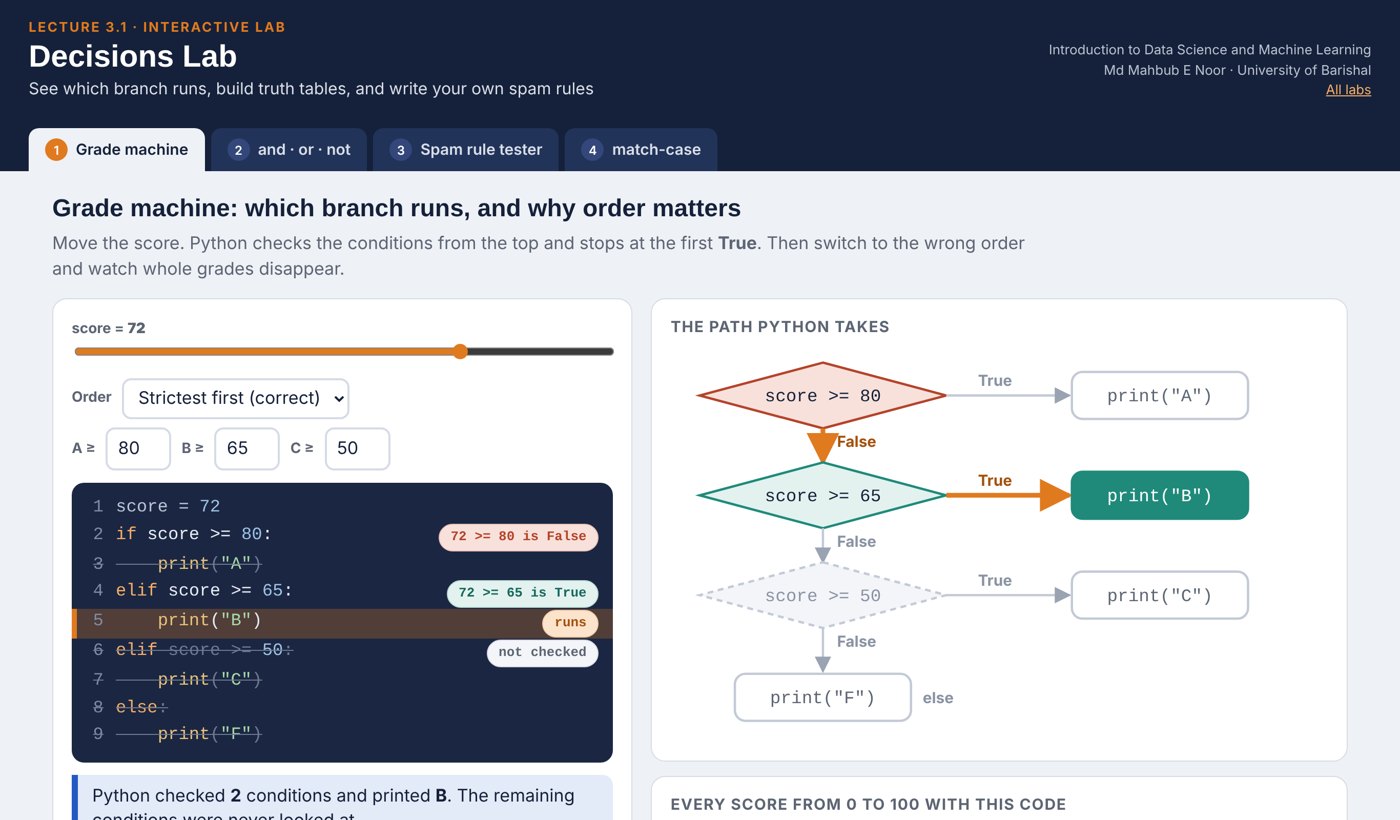
score = 72
if score >= 80:
    print("A")
elif score >= 65:
    print("B")
elif score >= 50:
    print("C")
else:
print("F")B
score >= 80print("A")score >= 65print("B")score >= 50print("C")print("F")Tracing the elif chain
Python checks from the top and stops at the first True. Later conditions are not even checked.
if score >= 80:
    print("A")
elif score >= 65:
    print("B")
elif score >= 50:
    print("C")
else:
print("F")| score | >= 80 | >= 65 | >= 50 | prints |
|---|---|---|---|---|
| 95 | True | not checked | not checked | A |
| 72 | False | True | not checked | B |
| 55 | False | False | True | C |
| 20 | False | False | False | F |
Next row: arrow key or the ▶ button. Predict it first!
Watch it run: the elif chain
WATCH FOR
- score = 72 is checked against each condition
- 72 >= 80 is False: skip
- 72 >= 65 is True: print B
- Everything below is skipped
Silent video: press play, pause any time.
Does the order of elif matter?
Predict firstscore = 92
if score >= 50:
print("C")
elif score >= 65:
print("B")
elif score >= 80:
print("A")What will this print? Write your prediction as a comment before you run the cell.
Answer: Does the order of elif matter?
score = 92
if score >= 50:
    print("C")
elif score >= 65:
    print("B")
elif score >= 80:
print("A")C
92 >= 50is True, so Python stops at the first branch- The A and B branches can never run for any score
- Rule: put the strictest condition first
and, or, not: combining conditions
and needs both. or needs at least one. not flips True and False.
| You type | Python gives | Meaning |
|---|---|---|
True and True | True | both True, so True |
True and False | False | one False is enough to make and False |
False or True | True | one True is enough to make or True |
False or False | False | nothing True, so False |
not True | False | not flips the value |
5 > 3 and "a" in "cat" | True | real conditions combine the same way |
Combining conditions in an if
- Both parts must be True for
and - Each side of
andis a full condition - Write
age >= 18 and age <= 60, notage >= 18 and <= 60 - Try it: set has_id to False
age = 20
has_id = True
if age >= 18 and has_id:
    print("Can enter")
else:
print("Cannot enter")Can enter
An if inside an if (nesting)
- Each level indents 4 more spaces
- The inner question is asked only if the outer one is True
- Use nesting when the second question only makes sense after the first
- Otherwise
andkeeps the code flatter
marks = 72
attendance = 60
if marks >= 50:
    if attendance >= 75:
        print("Pass")
    else:
        print("Pass marks, low attendance")
else:
print("Fail")Pass marks, low attendance
Decisions about text: the first spam rule
inchecks whether text appears inside other text.lower()first, so FREE and free both matchor: any one suspicious word is enough- Lecture 3.3 turns this into a filter for a whole inbox
message = "Claim your FREE prize"
text = message.lower()
if "free" in text or "prize" in text:
    print("Suspicious")
else:
print("Looks normal")Suspicious
match-case: one value, many fixed options
matchcompares one value with several patterns|means or inside a casecase _:catches everything else, like elsenumber[:3]= first 3 characters (Lecture 3.2)- Needs Python 3.10+; Colab has it
number = "01711111111"
match number[:3]:
    case "017" | "013":
        print("Grameenphone")
    case "019" | "014":
        print("Banglalink")
    case "018":
        print("Robi")
    case _:
print("Unknown operator")Grameenphone
Common mistakes with decisions
Read the last line of an error first. It names the problem.
| What you typed | What Python says | What it means |
|---|---|---|
if marks >= 50
print("ok") | SyntaxError: expected ':' | Missing colon at the end of the if line. |
if marks = 50:
print("ok") | SyntaxError: invalid syntax. Maybe you meant '==' or ':=' instead of '='? | One = stores. To compare, use ==. |
if marks >= 50:
print("ok") | IndentationError: expected an indented block after 'if' statement on line 1 | The block must be indented under the if. |
if "5" > 3:
print("ok") | TypeError: '>' not supported between instances of 'str' and 'int' | Text and numbers cannot be compared. Convert with int("5"). |
In-class exercises
Work in pairs. 15 minutes. n % 2 is the remainder after dividing n by 2.
Even or odd
Given n, print Even or Odd. Test: 7 gives Odd, 10 gives Even.
Largest of three
Given a, b, c, print the largest using if/elif/else, without max(). Test: 4, 9, 2 gives 9.
Leap year
Leap if divisible by 4 and not by 100, or divisible by 400. Test: 2024 Leap, 1900 Not leap, 2000 Leap.
Operator check
Extend the match example with Teletalk (015) and Airtel (016). Print INV if the number is not exactly 11 characters.
Solutions
Show these after students have tried the exercises.
Solutions 1 and 2
Test every branch: try values that should give each possible answer.
n = 7
if n % 2 == 0:
    print("Even")
else:
    print("Odd")

a = 4
b = 9
c = 2
if a >= b and a >= c:
    print(a)
elif b >= c:
    print(b)
else:
print(c)Odd 9
Solution 3: leap year
The brackets group the first two conditions. Test the tricky years: 1900 and 2000.
year = 1900
if (year % 4 == 0 and year % 100 != 0) or year % 400 == 0:
    print("Leap")
else:
print("Not leap")Not leap
Solution 4: operator check
The else matters: without it, a wrong-length number would print INV and then also an operator name.
number = "0151234567"
if len(number) != 11:
    print("INV")
else:
    match number[:3]:
        case "017" | "013":
            print("Grameenphone")
        case "019" | "014":
            print("Banglalink")
        case "015":
            print("Teletalk")
        case "016":
            print("Airtel")
        case "018":
            print("Robi")
        case _:
print("INV")INV
Interactive lab: Decisions Lab
In the lab you can
- Grade machineMove the score, follow the path, then break it with the wrong elif order.
- and · or · notFlip p and q, build truth tables, and test the entry rule.
- Spam rule testerPick words, test the rule on 12 messages, count misses and false alarms.
- match-caseType a phone number and watch which case matches.
Opens in a new tab and works offline. All labs: labs/START_HERE.html
Today's toolkit
== != > < >= <= | Compare, gives True/False |
if condition: | Run the block only if True |
else: | Run when nothing above was True |
elif condition: | Another check, only if earlier failed |
and / or / not | Combine or flip conditions |
"x" in text | Does text contain x? |
match value: | Compare one value with many options |
case "a" | "b": | Matches a or b |
case _: | Anything else |
Homework 3.1
Due before Lecture 3.2 · [date]
Predict, then run
Write predictions as comments first: print(10 != 10), print(not (3 > 5)), print("a" in "Data" and 2 < 1).
Weather advice
Store a temperature. Print Cold (below 15), Pleasant (15 to 27) or Hot (above 27). Test 14, 15, 27, 28.
Ticket price
Price is 50 for age under 12 or students, 100 otherwise. Store age and is_student and print the price.
Spam level
Store a message. Print High if it contains both "win" and "cash", Medium if either, otherwise Low. Ignore capitals.
Find the bug
The "Does the order matter" slide prints C for 92. Fix the code and explain the bug in one sentence.
Recap: Lecture 3.1 in 90 seconds
Watch it again at home to revise.