Responsible ML and what's next
Fairness, privacy, and a first look at neural networks
Introduction to Data Science and Machine Learning · Md Mahbub E Noor · University of Barishal
MLPClassifier(hidden_layer_sizes=(64,))
The road ahead: machine learning
Today you will
- 1Explain how models can affect people unfairly
- 2Check a model's performance per group
- 3Protect privacy when collecting data
- 4Compute one artificial neuron by hand
- 5Train a small neural network and know where to go next
Models make decisions about people
Who gets a loan
A credit model trained on past approvals can repeat past unfairness.
Who gets seen first
A health model that works worse for one group puts that group at risk.
Who gets filtered out
A spam or CV filter can hide real messages or good candidates without anyone noticing.
Where unfairness comes from
The data
Some groups are under-represented, so the model learns less about them. Recall our 2011 UK spam data.
The labels
Labels written by people can carry their past decisions and biases.
The measurement
A feature may mean different things for different groups, or be missing more often for some.
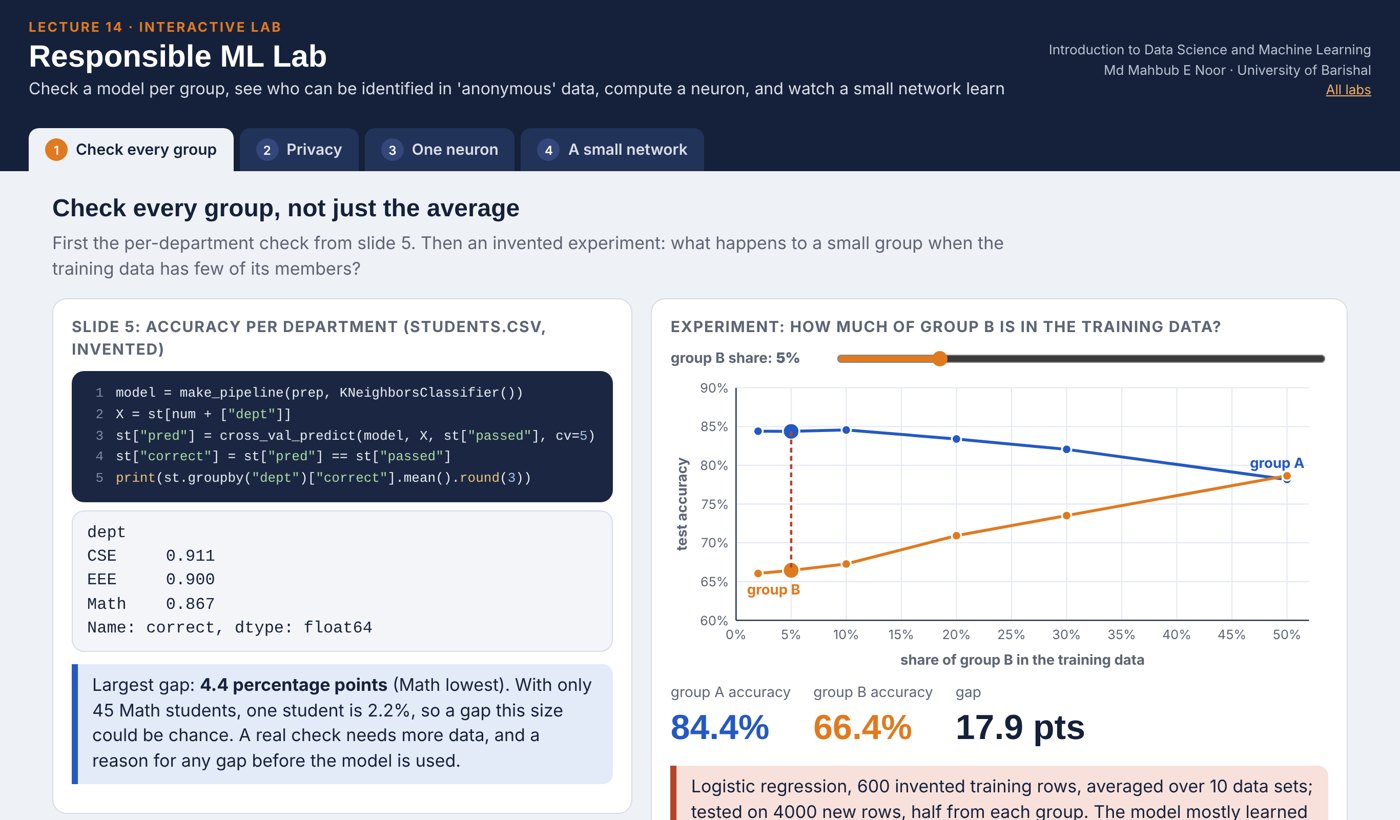
A simple, essential check: performance per group
cross_val_predict gives an honest prediction for every row · Then compare accuracy group by group · Large gaps need explaining before any use · students.csv is invented: this shows the method only
import pandas as pd
from sklearn.compose import make_column_transformer
from sklearn.impute import SimpleImputer
from sklearn.model_selection import cross_val_predict
from sklearn.neighbors import KNeighborsClassifier
from sklearn.pipeline import make_pipeline
from sklearn.preprocessing import OneHotEncoder
from sklearn.preprocessing import StandardScaler
st = pd.read_csv("students.csv")
num = ["hours", "attendance", "prior_gpa"]
prep = make_column_transformer(
    (make_pipeline(SimpleImputer(strategy="median"),
                   StandardScaler()), num),
    (OneHotEncoder(), ["dept"]))
model = make_pipeline(prep, KNeighborsClassifier())
X = st[num + ["dept"]]
st["pred"] = cross_val_predict(model, X, st["passed"], cv=5)
st["correct"] = st["pred"] == st["passed"]
print(st.groupby("dept")["correct"].mean().round(3))dept CSE 0.911 EEE 0.900 Math 0.867 Name: correct, dtype: float64
Privacy and consent
Collect only what you need
If a name or phone number does not help the question, do not collect it.
Remove identifiers
Delete names, numbers and addresses before analysis. Your SMS homework already did this.
Ask permission
People should know and agree when their data is used. Store it safely and delete it when done.
A checklist before trusting any model
| Check | Question to ask |
|---|---|
| Baseline | Does it clearly beat a simple guess? |
| Honest test | Was the test set used only once, at the end? |
| Right metric | Which mistake is costly, and is that metric reported? |
| Groups | Does it work similarly for different groups? |
| Data match | Does new data look like the training data (time, place, language)? |
| Privacy | Was the data collected with permission and anonymised? |
A first look at neural networks
A neuron
Multiplies each input by a weight, adds them up with a bias, and passes the result through a simple function.
Layers
Many neurons side by side form a layer; layers stacked together form a network.
Learning
Training adjusts the weights a little at a time to reduce the error, like the line search in Lecture 9.
By hand: one neuron
Inputs: hours 6, attendance 0.9, GPA 3.2. Weights 0.5, 2.0, 1.0, bias -5. Output 1 if the total is above 0.
# total = 6×0.5 + 0.9×2.0
#       + 3.2×1.0 - 5
#       = 3.0 + 1.8 + 3.2 - 5
#       = 3.0
# 3.0 > 0, so output 1
| input | value | weight | value × weight |
|---|---|---|---|
| hours | 6 | 0.5 | 3.0 |
| attendance | 0.9 | 2.0 | 1.8 |
| GPA | 3.2 | 1.0 | 3.2 |
| bias | -5 | ||
| total | 3.0 | ||
| output | 1 |
Next row: arrow key or the ▶ button. Predict it first!
Watch it: one neuron computing its output
WATCH FOR
- Each input is multiplied by its weight
- The products flow into the neuron and are added
- The bias is added: 8.0 - 5 = 3.0
- 3.0 > 0, so the output is 1
Silent video: press play, pause any time.
A small neural network on the digits
MLPClassifier: a multi-layer perceptron · One hidden layer of 64 neurons · Same fit / score pattern as every model · Compare with k-NN from Practice 3 on the same split
from sklearn.datasets import load_digits
from sklearn.model_selection import train_test_split
from sklearn.neural_network import MLPClassifier
X, y = load_digits(return_X_y=True)
X_tr, X_te, y_tr, y_te = train_test_split(
    X, y, test_size=0.25, random_state=0, stratify=y)
knn = KNeighborsClassifier(n_neighbors=1)
net = MLPClassifier(hidden_layer_sizes=(64,),
                    max_iter=1000, random_state=0)
for name, m in [("kNN k=1", knn), ("neural net", net)]:
    pipe = make_pipeline(StandardScaler(), m)
    pipe.fit(X_tr, y_tr)
print(name, round(pipe.score(X_te, y_te), 3))kNN k=1 0.967 neural net 0.973
Watch it: a small network learning
WATCH FOR
- The border starts almost straight
- Each round nudges every weight a little
- The error falls fast, then flattens
- After 200 rounds: 97% on these points
Silent video: press play, pause any time.
Where to go next
Deep learning
Larger networks for images, speech and text. Libraries: PyTorch, TensorFlow.
Language and speech
Bangla text and speech processing is an open area with real local impact.
Practice
Your project. Then public datasets and competitions, always with honest evaluation.
Interactive lab: Responsible ML Lab
In the lab you can
- Check every groupSlide 5 per department; a rare group gets worse results.
- PrivacyRemove names: how many people are still unique?
- One neuronSlide 9 with sliders: weights, bias, step or sigmoid.
- A small networkWatch the border bend epoch by epoch; 1 to 16 neurons.
Opens in a new tab and works offline. All labs: labs/START_HERE.html
Today's toolkit
cross_val_predict | Honest prediction for every row |
groupby(group)["correct"].mean() | Accuracy per group |
anonymise | Remove names, numbers, addresses |
neuron | Weighted sum + bias, then a function |
MLPClassifier(...) | A small neural network |
checklist | Baseline, honest test, metric, groups, data match, privacy |
Homework 14
Due before the project kickoff · [date]
By hand
For the neuron on the slide, find a student (hours, attendance, GPA) for whom the output is 0. Show the total.
Group check
Repeat the per-group check with a decision tree instead of k-NN. Do the groups differ more or less?
Network size
Train MLPClassifier on the digits with hidden layers of 8, 32 and 128 neurons. Report test accuracy for each.
Responsible use
Pick one real ML system you use. Write two ways it could treat some people unfairly.
Project idea
Write one paragraph describing a project you would like to do. Bring it to the kickoff.
Recap: Lecture 14 in 90 seconds
Watch it again at home to revise.