Evaluating models properly
Overfitting, cross-validation, precision and recall
Introduction to Data Science and Machine Learning · Md Mahbub E Noor · University of Barishal
cross_val_score(model, X, y, cv=5)
precision_score(y_te, pred)
The road ahead: machine learning
Today you will
- 1Recognise underfitting and overfitting
- 2Use a validation set or cross-validation to choose settings
- 3Compute precision, recall and F1 by hand
- 4Pick the right metric for the problem
- 5Spot the accuracy trap on imbalanced data
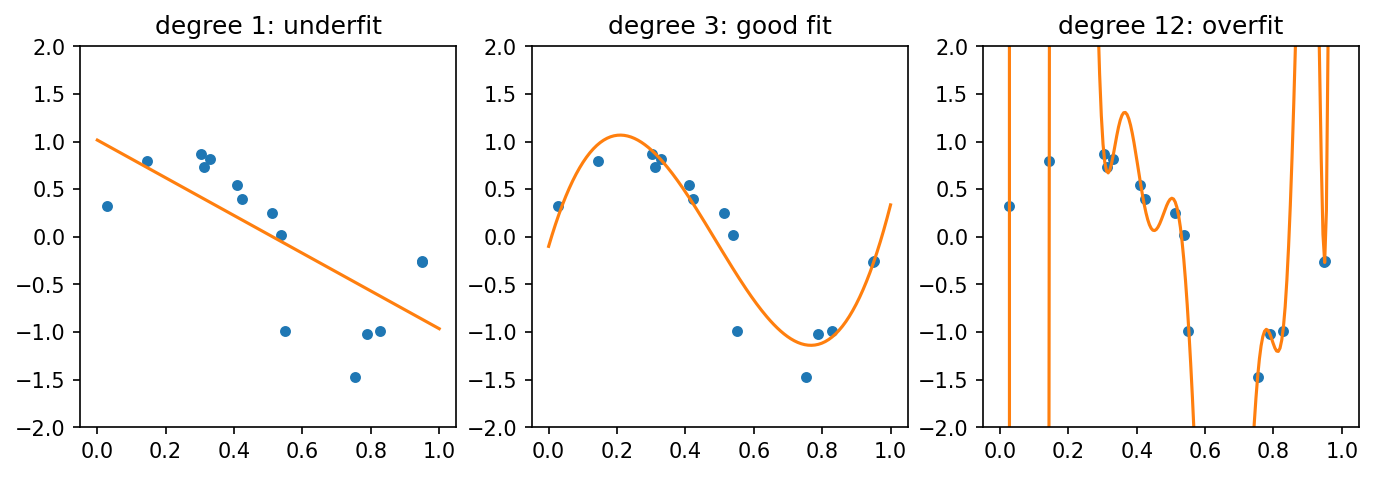
Too simple, just right, too complex
The same 15 noisy points (invented) fitted with curves of increasing flexibility. The right one follows the trend, not the noise.
import numpy as np
import matplotlib.pyplot as plt
rng = np.random.default_rng(1)
x = np.sort(rng.uniform(0, 1, 15))
y = np.sin(2 * np.pi * x) + rng.normal(0, 0.25, 15)
grid = np.linspace(0, 1, 200)
fig, axes = plt.subplots(1, 3, figsize=(11, 3.3))
for ax, deg, name in zip(axes, [1, 3, 12],
                         ["underfit", "good fit", "overfit"]):
    coefs = np.polyfit(x, y, deg)
    ax.scatter(x, y, s=18)
    ax.plot(grid, np.polyval(coefs, grid), color="tab:orange")
    ax.set_ylim(-2, 2)
    ax.set_title(f"degree {deg}: {name}")
plt.show()Too simple, just right, too complex: the result
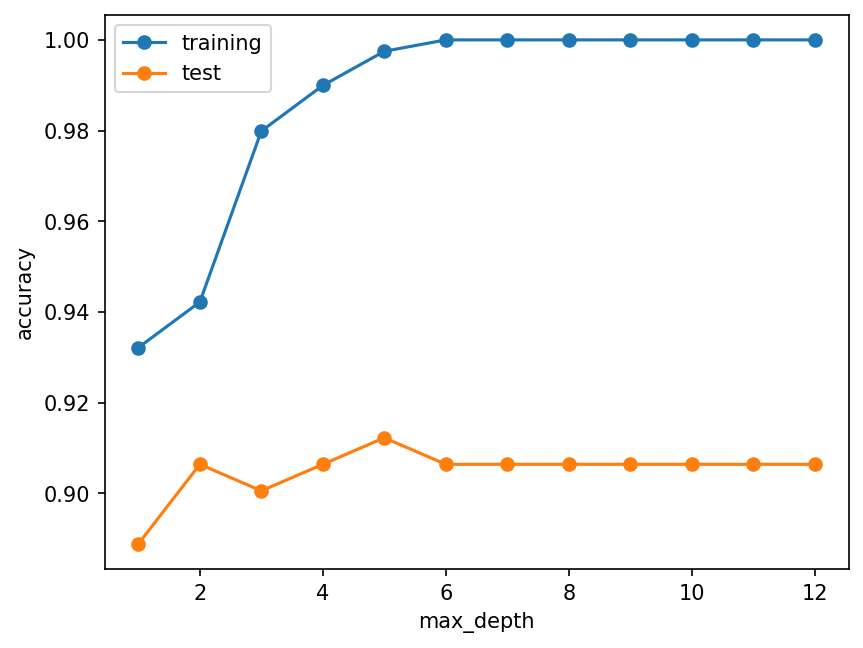
Overfitting in numbers: tree depth
Breast cancer data. As trees get deeper, training accuracy reaches 100% while test accuracy stops improving or drops.
from sklearn.datasets import load_breast_cancer
from sklearn.model_selection import train_test_split
from sklearn.tree import DecisionTreeClassifier
X, y = load_breast_cancer(return_X_y=True)
X_tr, X_te, y_tr, y_te = train_test_split(
    X, y, test_size=0.3, random_state=0, stratify=y)
depths = range(1, 13)
tr, te = [], []
for d in depths:
    t = DecisionTreeClassifier(max_depth=d, random_state=0)
    t.fit(X_tr, y_tr)
    tr.append(t.score(X_tr, y_tr))
    te.append(t.score(X_te, y_te))
plt.plot(list(depths), tr, marker="o", label="training")
plt.plot(list(depths), te, marker="o", label="test")
plt.xlabel("max_depth")
plt.ylabel("accuracy")
plt.legend()
plt.show()Overfitting in numbers: tree depth: the result
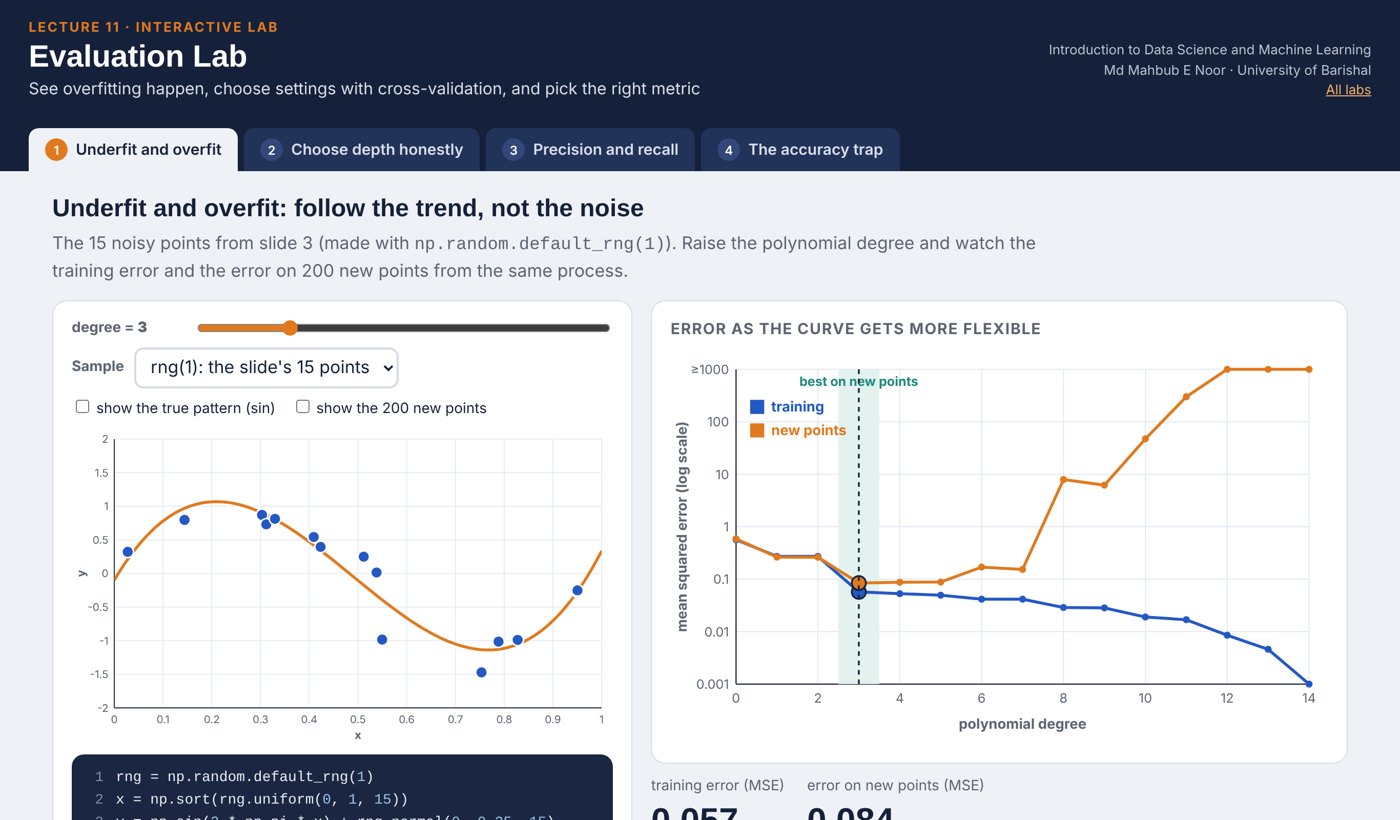
Watch it: from underfitting to overfitting
WATCH FOR
- The curve gets more flexible frame by frame
- Training error keeps falling
- Test error falls, then rises again
- The best model sits at the bottom of the test curve
Silent video: press play, pause any time.
Three sets, three jobs
Training set
The model learns from it with fit().
Validation set
We compare settings (k, depth) on it and pick the best.
Test set
Used once, at the very end, to report the final score.
5-fold cross-validation, pictured
Split the training data into 5 parts. Each round, one part validates and four train. Average the 5 scores.
# Every row is used for validation exactly once.
# 5 scores instead of 1:
#   - a more reliable average
#   - and a sense of how much it varies
| part 1 | part 2 | part 3 | part 4 | part 5 | |
|---|---|---|---|---|---|
| round 1 | VALID | train | train | train | train |
| round 2 | train | VALID | train | train | train |
| round 3 | train | train | VALID | train | train |
| round 4 | train | train | train | VALID | train |
| round 5 | train | train | train | train | VALID |
Next row: arrow key or the ▶ button. Predict it first!
Cross-validation in one line
cross_val_score runs all 5 rounds · Use only the training data · Report the mean and the spread · Choose depth by mean CV score, not by test score
from sklearn.model_selection import cross_val_score
for d in [2, 3, 5, 10]:
    t = DecisionTreeClassifier(max_depth=d, random_state=0)
    scores = cross_val_score(t, X_tr, y_tr, cv=5)
print(d, scores.round(3), round(scores.mean(), 3))2 [0.95 0.95 0.9 0.899 0.962] 0.932 3 [0.962 0.912 0.888 0.899 0.962] 0.925 5 [0.95 0.9 0.912 0.911 0.975] 0.93 10 [0.95 0.888 0.912 0.899 0.975] 0.925
Then, and only then, the test set
- Cross-validation picked max_depth = 2
- Fit it on all training data
- Score the test set once
- That number is what you report
best = DecisionTreeClassifier(max_depth=2, random_state=0)
best.fit(X_tr, y_tr)
print(round(best.score(X_te, y_te), 3))
0.906
By hand: precision, recall and F1 for our spam model
Our Lecture 6 results: TP = 117 spam caught, FP = 5 real messages flagged, FN = 14 spam missed.
# precision: of the messages flagged as spam,
#            how many really were spam?
# recall:    of all real spam,
#            how much did we catch?
# F1: one number balancing both
| metric | formula | numbers | value |
|---|---|---|---|
| precision | TP / (TP + FP) | 117 / 122 | 0.959 |
| recall | TP / (TP + FN) | 117 / 131 | 0.893 |
| F1 | 2PR / (P + R) | 2·P·R / (P + R) | 0.925 |
Next row: arrow key or the ▶ button. Predict it first!
Which metric matters?
| Problem | Worse mistake | Watch especially |
|---|---|---|
| Spam filter | Losing a real message (false positive) | Precision |
| Disease screening | Missing a sick patient (false negative) | Recall |
| Fraud alerts | Both are costly | F1, then discuss |
| Balanced, low-stakes task | Neither stands out | Accuracy is fine |
The accuracy trap
Predict firstfrom sklearn.metrics import accuracy_score, recall_score y_true = [0] * 95 + [1] * 5 y_pred = [0] * 100 print(accuracy_score(y_true, y_pred)) print(recall_score(y_true, y_pred))
95 healthy people, 5 sick. A 'model' always answers healthy. What are its accuracy and recall?
Answer: The accuracy trap
from sklearn.metrics import accuracy_score, recall_score
y_true = [0] * 95 + [1] * 5
y_pred = [0] * 100
print(accuracy_score(y_true, y_pred))
print(recall_score(y_true, y_pred))
0.95
0.0
- Accuracy 95%: sounds excellent
- Recall 0: it finds no sick person at all
- On imbalanced data, accuracy hides failure
- Always check recall and precision for the rare class
All the metrics at once
classification_reportgives precision, recall and F1 per class- support = how many test rows of each class
- In this dataset, class 0 = malignant
- Read the row of the class you care most about
from sklearn.metrics import classification_report
pred = best.predict(X_te)
print(classification_report(y_te, pred,
target_names=["malignant", "benign"], digits=3)) precision recall f1-score support
malignant 0.843 0.922 0.881 64
benign 0.950 0.897 0.923 107
accuracy 0.906 171
macro avg 0.897 0.910 0.902 171
weighted avg 0.910 0.906 0.907 171Your turn 10 minutes
- 1Use cross_val_score to choose k for k-NN on the breast cancer training data (k = 1, 5, 15, 31)
- 2Fit the best k on all training data
- 3Print its classification_report on the test set
- 4What is the recall for malignant tumours?
from sklearn.neighbors import KNeighborsClassifier
for k in [1, 5, 15, 31]:
    s = cross_val_score(KNeighborsClassifier(n_neighbors=k),
                        X_tr, y_tr, cv=5)
    print(k, round(s.mean(), 3))
...
Starter code: replace the ... with your own code
Common evaluation mistakes
Read the last line of an error first. It names the problem.
| What you typed | What Python says | What it means |
|---|---|---|
cross_val_score(best, X_tr, y_tr, scoring="acuracy") | InvalidParameterError: The 'scoring' parameter of cross_val_score must be a str among {'homogeneity_score', 'recall', 'a ... | Misspelt metric name. The message lists valid names. |
recall_score(["a", "b"], ["a", "a"]) | ValueError: pos_label=1 is not a valid label. It should be one of ['a', 'b'] | With text labels, say which one is positive: pos_label="b". |
cross_val_score(best, X_tr, y_tr[:100], cv=5) | ValueError: Found input variables with inconsistent numbers of samples: [398, 100] | X and y must have the same number of rows. |
Interactive lab: Evaluation Lab
In the lab you can
- Underfit and overfitRaise the polynomial degree; watch error on new points.
- Choose depth honestly5-fold CV picks the depth; the test set is scored once.
- Precision and recallThe spam model's threshold, matrix and PR curve.
- The accuracy trapRare disease, lazy model: 95% accuracy, 0 recall.
Opens in a new tab and works offline. All labs: labs/START_HERE.html
Today's toolkit
underfit / overfit | Too simple / memorises noise |
cross_val_score(m, X, y, cv=5) | 5 validation scores |
precision | TP / (TP + FP) |
recall | TP / (TP + FN) |
F1 | Balance of precision and recall |
classification_report | All metrics per class |
test set | Used once, at the end |
Homework 11
Due before Lecture 12 · [date]
By hand
A model has TP = 40, FP = 10, FN = 20, TN = 130. Compute accuracy, precision, recall and F1.
Choose depth honestly
On wine, choose max_depth with 5-fold cross-validation on the training data, then report the test accuracy once.
Metric choice
For three problems of your choice, say which mistake is worse and which metric you would watch.
Variation
Print the 5 CV scores for one model. What are the smallest and largest? Why do they differ?
Explain
In 3 sentences: why is choosing settings on the test set a form of cheating?
Recap: Lecture 11 in 90 seconds
Watch it again at home to revise.