What is machine learning?
Learning from examples: the ideas behind every model
Introduction to Data Science and Machine Learning · Md Mahbub E Noor · University of Barishal
model.fit(X_train, y_train)
model.predict(X_test)
The road ahead: machine learning
Today you will
- 1Explain machine learning as learning a function from examples
- 2Tell supervised from unsupervised learning
- 3Tell classification from regression
- 4Use the fit / predict pattern with any scikit-learn model
- 5Explain why we judge a model on data it has never seen
Machine learning in one sentence
Examples in
We give the computer many examples: inputs (features) and, often, the right answers (labels).
Pattern learned
An algorithm finds a rule, called a model, that maps inputs to answers.
New answers out
The model predicts answers for inputs it has never seen. That is the whole point.
Supervised or unsupervised?
Supervised (labels given)
- Every example has the right answer
- Goal: predict the answer for new inputs
- Spam filter, price prediction, diagnosis
- Lectures 9 to 12
Unsupervised (no labels)
- Only inputs, no answers
- Goal: find structure, such as groups
- Customer segments, topic grouping
- Lecture 13
Classification or regression?
Ask: is the answer a category or a number?
| Question | Answer looks like | Type |
|---|---|---|
| Is this message spam? | spam / ham | Classification |
| What mark will this student get? | a number, e.g. 78.5 | Regression |
| Which flower species is this? | one of 3 names | Classification |
| How many units will sell next week? | a number | Regression |
| Will this loan be repaid? | yes / no | Classification |
The machine learning workflow
The same workflow as Lecture 6, for any dataset. Most of the work is before training.
Meet a classic dataset: iris flowers
150 flowers, 4 measurements each (in cm), 3 species. It ships with scikit-learn, so it works offline.
| sepal length | sepal width | petal length | petal width | species (label) |
|---|---|---|---|---|
| 5.1 | 3.5 | 1.4 | 0.2 | setosa |
| 7.0 | 3.2 | 4.7 | 1.4 | versicolor |
| 6.3 | 3.3 | 6.0 | 2.5 | virginica |
| 4.9 | 3.0 | 1.4 | 0.2 | setosa |
| 6.4 | 3.2 | 4.5 | 1.5 | versicolor |
Look first: can the classes be told apart?
Two petal measurements already separate the species well. Machine learning finds such patterns automatically, in many dimensions.
import matplotlib.pyplot as plt
from sklearn.datasets import load_iris
iris = load_iris(as_frame=True)
X = iris.data
y = iris.target
for k, name in enumerate(iris.target_names):
    part = X[y == k]
    plt.scatter(part["petal length (cm)"],
                part["petal width (cm)"], label=name)
plt.xlabel("petal length (cm)")
plt.ylabel("petal width (cm)")
plt.legend()
plt.show()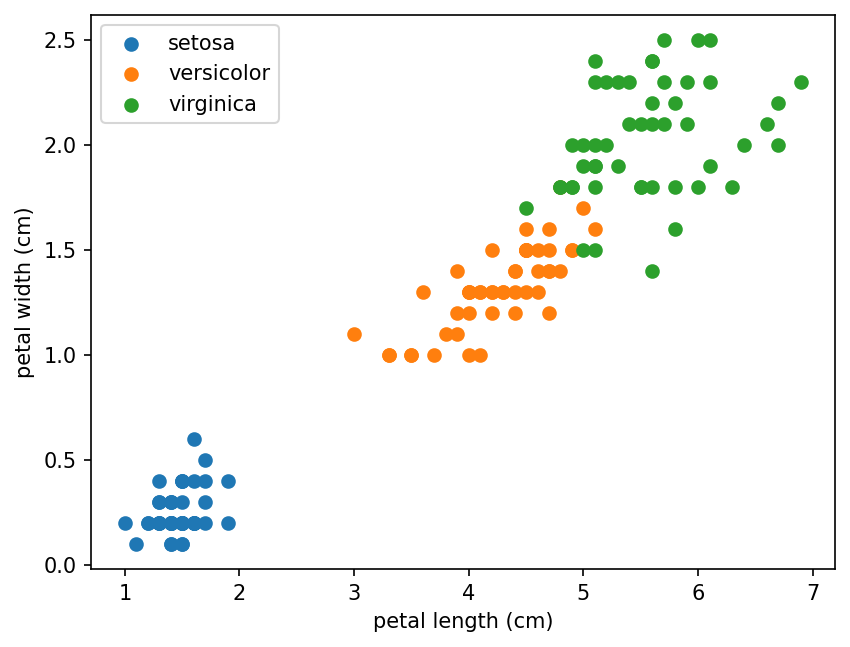
The same pattern for every model
- Split first, with the same function as Lecture 6
fitlearns from training datascorereports accuracy on test data- Swap the model; the code stays the same
from sklearn.model_selection import train_test_split
from sklearn.neighbors import KNeighborsClassifier
from sklearn.tree import DecisionTreeClassifier
from sklearn.naive_bayes import GaussianNB
X_tr, X_te, y_tr, y_te = train_test_split(
    X, y, test_size=0.3, random_state=42, stratify=y)
for model in [KNeighborsClassifier(),
              DecisionTreeClassifier(random_state=0),
              GaussianNB()]:
    model.fit(X_tr, y_tr)
    acc = model.score(X_te, y_te)
print(type(model).__name__, round(acc, 3))KNeighborsClassifier 0.978 DecisionTreeClassifier 0.978 GaussianNB 0.911
100% on training data: a perfect model?
Predict firstone_nn = KNeighborsClassifier(n_neighbors=1) one_nn.fit(X_tr, y_tr) print(one_nn.score(X_tr, y_tr)) print(round(one_nn.score(X_te, y_te), 3))
A 1-nearest-neighbour model scores 100% on its training data. What will it score on the test data?
Answer: 100% on training data: a perfect model?
one_nn = KNeighborsClassifier(n_neighbors=1)
one_nn.fit(X_tr, y_tr)
print(one_nn.score(X_tr, y_tr))
print(round(one_nn.score(X_te, y_te), 3))
1.0
0.933
- On training data it just finds each flower itself
- That is memorising, not learning
- Only the test score shows real skill
- Never report training accuracy as your result
Generalisation: the real goal
Memorising
Learning the exact exam questions. Perfect on those, lost on new ones.
Generalising
Understanding the patterns, so new questions can be answered too.
How we check
Keep a test set the model never sees, and judge it only there.
Watch it: memorising vs generalising
WATCH FOR
- k = 1 wraps a border around every training point
- 100% on training data, 74% on new points
- k = 15 is smoother: 87% on training data
- But 88% on new points: it generalises better
Silent video: press play, pause any time.
Vocabulary for the rest of the course
| Word | Meaning |
|---|---|
| Feature (X) | An input column the model uses |
| Label / target (y) | The answer we want to predict |
| Model | The learned rule that maps features to a label |
| Training (fit) | Learning the rule from examples |
| Prediction | The model's answer for a new example |
| Hyperparameter | A setting we choose, e.g. k in k-nearest neighbours |
| Generalisation | Doing well on data the model has never seen |
Your turn 8 minutes
- 1Load the wine dataset:
from sklearn.datasets import load_wine - 2Split it 70/30 with
stratify - 3Score the same three models
- 4Which model wins? Is it the same as for iris?
from sklearn.datasets import load_wine
wine = load_wine(as_frame=True)
X, y = wine.data, wine.target
...
Starter code: replace the ... with your own code
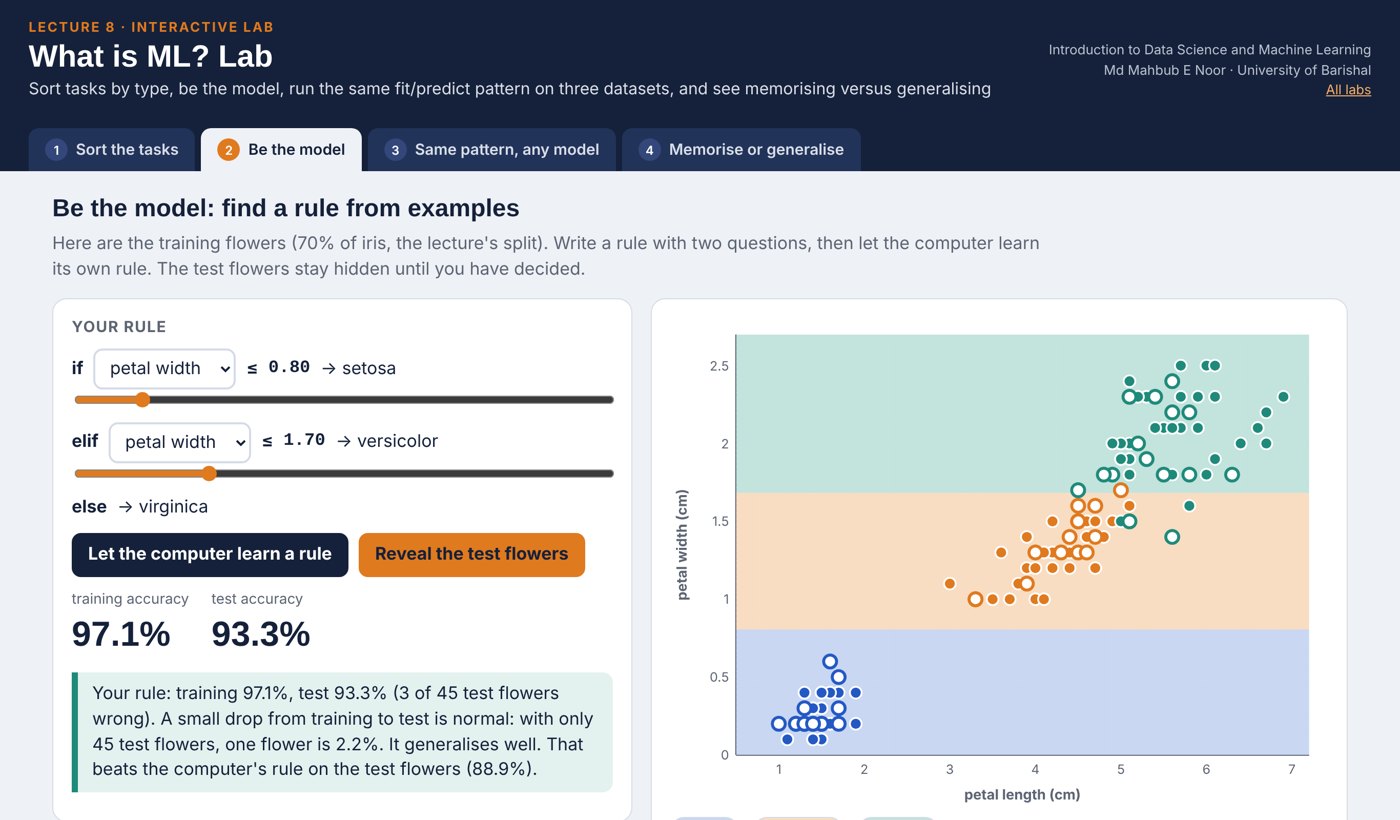
Interactive lab: What is ML? Lab
In the lab you can
- Sort the tasks12 questions: supervised or not, category or number.
- Be the modelWrite a two-question rule for iris, then meet the tree's.
- Same pattern, any modelfit / score on iris, wine, breast cancer; guess the winner.
- Memorise or generalisek-NN from k = 1 to 101: training vs new points.
Opens in a new tab and works offline. All labs: labs/START_HERE.html
Today's toolkit
supervised | Learn from labelled examples |
unsupervised | Find structure without labels |
classification | Predict a category |
regression | Predict a number |
model.fit(X, y) | Train |
model.predict(X) | Answer for new rows |
model.score(X, y) | Accuracy (classifiers) |
test set | Data the model never sees in training |
Homework 8
Due before Lecture 9 · [date]
Classify the task
Write 6 prediction questions from daily life. Label each: classification or regression, supervised or unsupervised.
Features and label
For two of your questions, list 3 useful features and the label.
Three models
Repeat the 'same pattern' slide on load_breast_cancer. Report the three test accuracies.
Train vs test
For KNeighborsClassifier(n_neighbors=1) on breast cancer, print training and test accuracy. Explain the gap.
Explain
In 3 sentences: why do we judge a model only on data it has not seen?
Recap: Lecture 8 in 90 seconds
Watch it again at home to revise.