Build a real spam detector
From 5,169 messages to a working model, step by step
Introduction to Data Science and Machine Learning · Md Mahbub E Noor · University of Barishal
model = MultinomialNB()
model.fit(X_train_counts, y_train)
Where we are on the road to a spam detector
Today you will
- 1Load and clean the data (Lecture 5)
- 2Split into training and test sets
- 3Turn words into numbers
- 4Train a Naive Bayes model
- 5Predict, evaluate honestly, and try your own messages
Seven steps from raw text to predictions
The same seven steps work for most classification problems: plant disease photos, speech emotion, fraud.
Step 1: Load and clean
- Same loading code as Lecture 5; in the lab use
"sms.tsv"instead ofurl - Drop duplicates so test messages are truly new
- 5,169 unique messages remain
X= the messages (input),y= the labels (answer)
import pandas as pd
url = ("https://raw.githubusercontent.com/"
       "justmarkham/pycon-2016-tutorial/"
       "master/data/sms.tsv")
df = pd.read_csv(url, sep="\t", header=None,
                 names=["label", "message"])
df = df.drop_duplicates()
X = df["message"]
y = df["label"]
print(df.shape)(5169, 2)
Step 2: Split into study and exam sets
- The model studies the training set (80%)
- We grade it on the test set (20%) it has never seen
stratify=ykeeps the same spam share in bothrandom_state=42makes the split repeatable
from sklearn.model_selection import train_test_split

X_train, X_test, y_train, y_test = train_test_split(
    X, y, test_size=0.2, random_state=42,
    stratify=y)
print(len(X_train), len(X_test))4135 1034
Step 3: What "words to numbers" means
Models only understand numbers. CountVectorizer builds a table: one row per message, one column per word, each cell a count.
| Message | win | free | prize | now | lunch | class |
|---|---|---|---|---|---|---|
| Win a free prize, win now | 2 | 1 | 1 | 1 | 0 | 0 |
| Free lunch now | 0 | 1 | 0 | 1 | 1 | 0 |
| See you in class | 0 | 0 | 0 | 0 | 0 | 1 |
This is count_words() from Lecture 4, done for every message and arranged as a table. Word order is lost: it is a “bag of words”.
Step 3: Words to numbers, in code
fit_transformon training data: learn the vocabulary, then counttransformon test data: count only, using that vocabulary- 7,680 different words learned
- Never fit on the test set: that would peek at the exam
from sklearn.feature_extraction.text import (
    CountVectorizer)

vec = CountVectorizer()
X_train_counts = vec.fit_transform(X_train)
X_test_counts = vec.transform(X_test)
print(X_train_counts.shape)(4135, 7680)
Step 3, up close: fit learns, transform reuses
fitreads the training messages and builds the vocabularytransformcounts words using that vocabulary only- "tomorrow" was never seen in training, so it is ignored
- "a" is dropped: by default, one-letter words are skipped
demo = CountVectorizer()
demo.fit(["win a free prize", "see you in class"])
print(demo.get_feature_names_out())
print(demo.transform(["free class tomorrow"]).toarray())
['class' 'free' 'in' 'prize' 'see' 'win' 'you']
[[1 1 0 0 0 0 0]]
Step 4: Train the model
- Multinomial Naive Bayes: the model from Lecture 1's demo
fit= learn from examples: counts words per label- Training takes well under a second
- This is our spam_score idea, with proper probabilities
from sklearn.naive_bayes import MultinomialNB

model = MultinomialNB()
model.fit(X_train_counts, y_train)
print("Training done!")Training done!
Step 5: Predict messages it has never seen
predictlabels all 1,034 test messages- Put truth and prediction side by side
- Here 5 of 6 are right; one spam slipped through
- Next: count mistakes over the whole test set
predictions = model.predict(X_test_counts)
check = pd.DataFrame({"message": X_test.str[:28],
                      "truth": y_test,
                      "predicted": predictions})
print(check.sample(6, random_state=42))message truth predicted 2599 Okie... Thanx... ham ham 1207 As a SIM subscriber, you are spam spam 5147 Get your garden ready for su spam spam 3332 How much it will cost approx ham ham 788 Ever thought about living a spam ham 1972 Enjoy ur life. . Good night ham ham
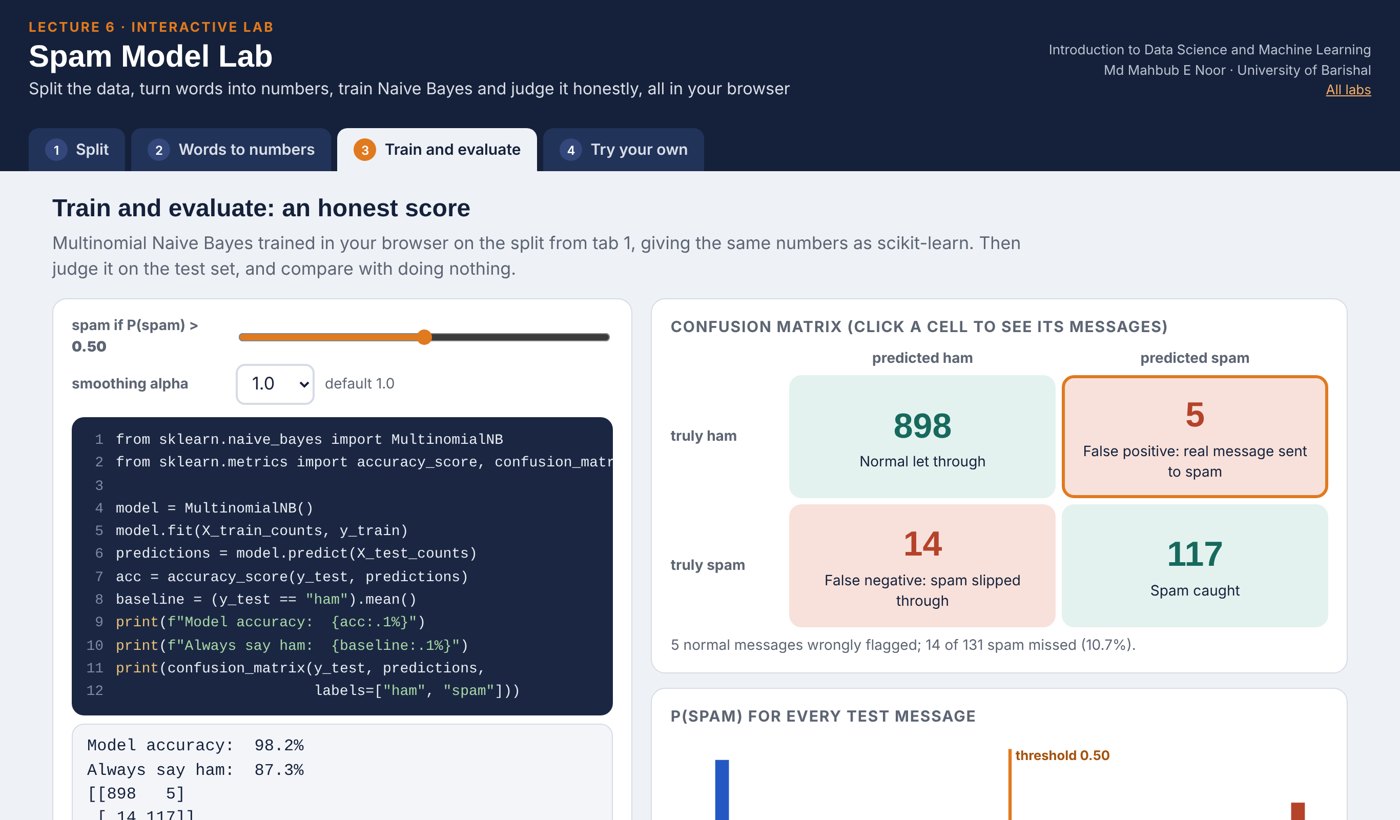
Step 6: Evaluate, and compare with doing nothing
from sklearn.metrics import accuracy_score

acc = accuracy_score(y_test, predictions)
baseline = (y_test == "ham").mean()
print(f"Model accuracy:  {acc:.1%}")
print(f"Always say ham: {baseline:.1%}")Model accuracy: 98.2% Always say ham: 87.3%
Our model
Always says "ham"
Step 6: Which mistakes does it make?
from sklearn.metrics import confusion_matrix
print(confusion_matrix(y_test, predictions,
labels=["ham", "spam"]))[[898 5] [ 14 117]]
- Rows: the truth. Columns: the prediction.
- 5 normal messages wrongly flagged
- 14 of 131 spam missed: about 1 in 9
- Which mistake is worse for a user?
Watch it: from split to an honest score
WATCH FOR
- stratify keeps the spam share equal in both parts
- The test set stays hidden during training
- Each test message lands in one matrix cell
- Accuracy compared with always saying ham
Silent video: press play, pause any time.
Step 7: Try your own messages
- New text goes through the same
vec.transform predict_probagives [ham, spam] probabilities- Classic prize spam: caught with near certainty
- A modern parcel scam slips through: it is not like 2011 spam
tests = [
    "Congratulations! You won a free prize. Call now!",
    "Are we still meeting at the library tomorrow?",
    "Your parcel is waiting, pay the delivery fee"]
new_counts = vec.transform(tests)
print(model.predict(new_counts))
print(model.predict_proba(new_counts).round(2))['spam' 'ham' 'ham'] [[0. 1. ] [1. 0. ] [0.83 0.17]]
Look inside: what did it learn?
- For each word: how much more likely in spam than ham
- Top clues: claim, prize, guaranteed, www
- "150p" is a UK price code, a sign of the data's origin
- Nobody typed these rules; they came from the data
import numpy as np

words = vec.get_feature_names_out()
lp = model.feature_log_prob_
diff = lp[1] - lp[0]
top = np.argsort(diff)[-10:][::-1]
print(list(words[top]))
['claim', 'prize', '150p', 'tone', 'co', 'www', '18',
'guaranteed', '500', '1000']
Honest limits of our model
Old, foreign data
Mostly UK and Singapore messages from around 2011. New scam styles are unseen.
One small test
1,034 test messages, one random split. Another split gives a slightly different score.
Words only
It ignores word order, the sender and links. "FR33" tricks can still work.
Mistakes have costs
A real message lost in the spam folder can matter more than one spam let through.
The whole pipeline, start to finish
Everything from today in one cell. This short program is a complete, real machine learning project.
import pandas as pd
from sklearn.model_selection import train_test_split
from sklearn.feature_extraction.text import CountVectorizer
from sklearn.naive_bayes import MultinomialNB
from sklearn.metrics import accuracy_score

url = ("https://raw.githubusercontent.com/justmarkham/"
       "pycon-2016-tutorial/master/data/sms.tsv")
df = pd.read_csv(url, sep="\t", header=None,
                 names=["label", "message"]).drop_duplicates()
X_tr, X_te, y_tr, y_te = train_test_split(
    df["message"], df["label"], test_size=0.2,
    random_state=42, stratify=df["label"])
vec = CountVectorizer()
model = MultinomialNB().fit(vec.fit_transform(X_tr), y_tr)
pred = model.predict(vec.transform(X_te))
print(f"Accuracy: {accuracy_score(y_te, pred):.1%}")Accuracy: 98.2%
Two classic machine learning mistakes
Read the last line of an error first. It names the problem.
| What you typed | What Python says | What it means |
|---|---|---|
model.predict(["Win cash now"]) | ValueError: Expected 2D array, got 1D array instead: | The model needs numbers. Use model.predict(vec.transform([...])). |
vec2 = CountVectorizer() X_bad = vec2.fit_transform(X_test) model.predict(X_bad) | ValueError: X has 3320 features, but MultinomialNB is expecting 7680 features as input. | A new vocabulary no longer matches the model. Fit only on training data; use vec.transform for new text. |
Interactive lab: Spam Model Lab
In the lab you can
- SplitChange test_size, random_state and stratify; see every message.
- Words to numbersBuild the bag-of-words table that CountVectorizer makes.
- Train and evaluateConfusion matrix you can click, and a threshold slider.
- Try your ownWord-by-word evidence for any message you type.
Opens in a new tab and works offline. All labs: labs/START_HERE.html
Homework 6: mini-project
Due: [date, about two weeks from today]
Rebuild it
Type the full pipeline in your own notebook, one step per cell, with a text cell explaining each step in your own words.
Baseline and mistakes
Report accuracy, the always-ham baseline, and the confusion matrix. Explain each cell of the matrix in one sentence.
Experiment
Try CountVectorizer(stop_words="english") and random_state=7. What changes? Keep a small table of results.
Fool the model
Write 3 spam messages designed to slip through. Did they? Explain why they worked or failed.
Local test
Collect 10 SMS (5 spam, 5 normal), remove all personal details, and test them. How many are right? Why might this differ from the test score?
Reflect
One paragraph: would you trust this filter on your own phone? What would you change first?
Recap: Lecture 6 in 90 seconds
Watch it again at home to revise.